
The EU’s Critical Raw Materials Act (CRM Act), which entered into force in 2024, represents one of the most significant industrial policy initiatives in recent years. While much of the discussion has focused on increasing domestic mining and reducing reliance on imported resources, the legislation is ultimately about strengthening the entire critical minerals supply chain in Europe.
At its core, the Act recognises that long-term resource security depends not only on securing access to new supplies of critical raw materials but also on retaining and recovering the materials already circulating within the economy. By treating waste streams, industrial by-products and secondary materials as strategic resources, the CRM Act places circularity at the heart of Europe’s approach to critical raw materials.
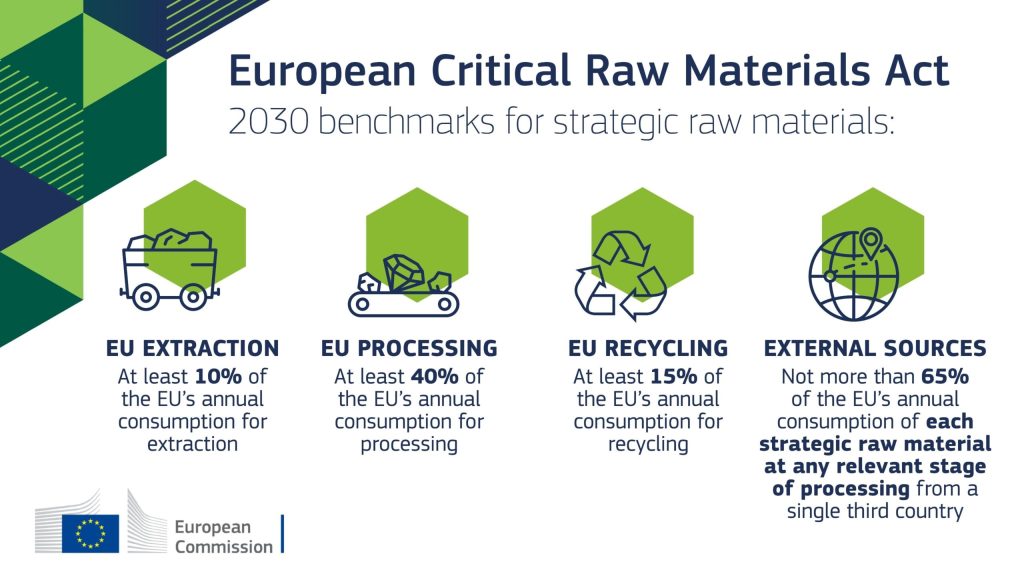
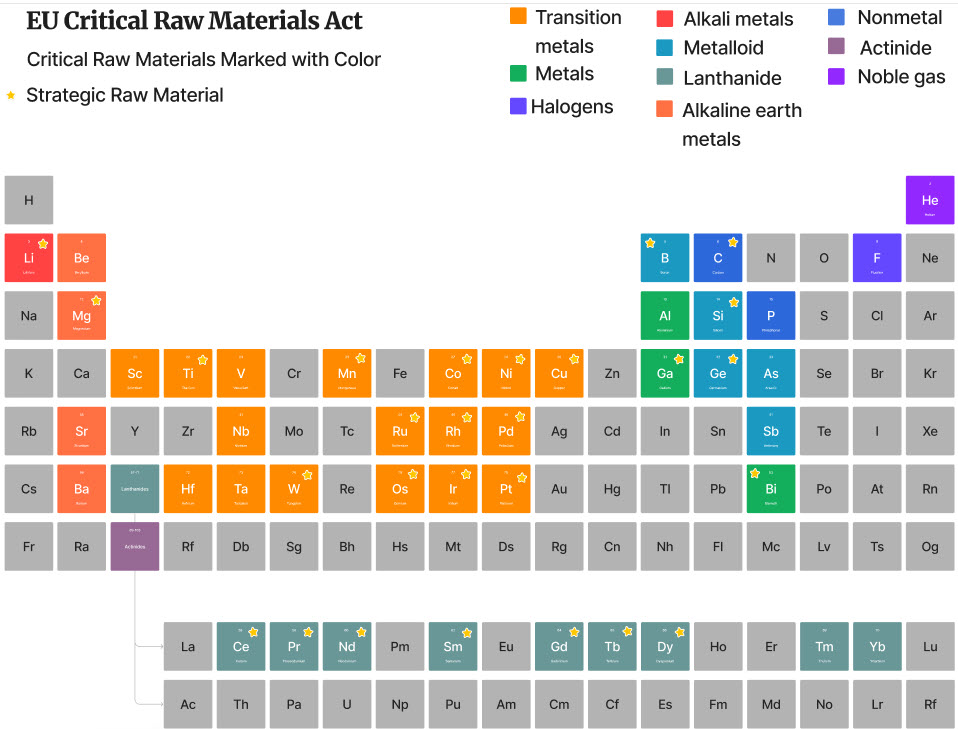
The ambitious legislation aims for the EU to meet at least 10% of annual consumption through domestic extraction, process 40% within Europe, and source 25% from recycling by 2030. It also caps reliance on any single non-EU supplier at 65% of annual consumption for each strategic raw material, and identifies 34 critical raw materials and 17 strategic raw materials (including nickel, copper and the platinum group metals) that are essential to Europe’s green, digital and defence technologies. These targets are designed to reduce dependency on external suppliers while building a more resilient and competitive critical minerals supply chain capable of supporting Europe’s internal industrial ambitions.
Domestic extraction
Processed in Europe
From recycling by 2030
For Europe to build a truly circular economy, circularity should start already within industrial production processes, not only at the end-of-life stage. While Extended Producer Responsibility (EPR) schemes play an important role in improving product design and post-consumer waste management, they do not specifically address the recovery of valuable liquid and solid industrial process streams, such as wastewater, process liquors and production residues. These streams therefore require dedicated policy attention if Europe is to maximise its domestic secondary raw material potential.
Industrial wastewater generated by sectors such as surface treatment, electroplating, mining, metal processing, battery manufacturing, and electronics production frequently contains valuable metals, including nickel, copper and ruthenium. In many cases, these materials are present in dissolved or suspended forms that are difficult to recover using conventional treatment methods.
Although wastewater is routinely treated before discharge, resource recovery is rarely the primary objective or an objective at all. Instead, many treatment processes generate large volumes of sludge that continue to contain significant concentrations of valuable metals. This sludge is often sent to landfill or requires costly disposal, resulting in both environmental impacts and the permanent loss of strategic resources.In effect, conventional treatment converts a recoverable resource into a hazardous liability and pushes the metal one step further out of the European supply chain.
This is precisely the loss the CRM Act is designed to prevent, and it is where upstream recovery changes the equation. Advanced recovery technologies, including processes such as Supercritical Water Precipitation (SWaP)™, can extract and concentrate dissolved metals from industrial wastewater streams before they become waste. Rather than allowing these materials to leave the industrial system altogether, recovery technologies can return them to the critical minerals supply chain as secondary raw materials.
In doing so, recovery transforms wastewater from a cost centre into a source of real economic value while supporting the EU’s broader resource security objectives.
The growing importance of resource recovery is driven by a simple reality: demand for critical raw materials is accelerating rapidly.
The energy transition, electrification of transport, advanced manufacturing and the expansion of digital infrastructure are all increasing demand for metals that are already subject to supply constraints. According to the International Energy Agency, demand for lithium is expected to increase by more than 350% between 2024 and 2040, while demand for cobalt and magnet rare earths is also forecast to grow substantially. The Commission’s own projections are starker still: EU lithium demand could rise twelve-fold by 2030, and rare earth demand six-fold, driven by electromobility and renewable energy.
These materials are essential not only for batteries and renewable energy technologies but also for semiconductors, artificial intelligence infrastructure, robotics, aerospace systems, and advanced defence capabilities. These technologies will ultimately improve the lives of European citizens.
At the same time, global supply chains remain highly concentrated. Processing capacity for many critical raw materials remains located outside Europe, creating vulnerabilities that have become increasingly apparent amid geopolitical tensions, resource nationalism and trade disruptions.
For policymakers, the CRM Act is therefore far more than an environmental or industrial policy. It is increasingly viewed as a prerequisite for strategic autonomy in Europe. By reducing dependence on concentrated external supply chains and increasing domestic capacity for extraction, processing, and recovery, the Act aims to strengthen Europe’s resilience in an increasingly uncertain geopolitical environment.
Primary extraction will remain a cornerstone of the CRM strategy, but Europe has limited domestic reserves of virgin critical raw materials making mining alone unlikely to meet future demand. For this reason, recycling and secondary raw materials will play a crucial role in meeting Europe’s critical minerals needs and improving long-term resource security. This ambition should be matched by stronger support for identifying, mapping and characterising waste streams containing CRMs as these represent a strategic domestic resource that is still largely overlooked.
The CRM Act creates important policy momentum, but achieving its objectives will depend on implementation. The urgency is not abstract: in early 2026 the European Court of Auditors warned that the EU risks falling short of its 2030 supply targets, citing limited progress in scaling domestic production, refining and recycling. Of the three benchmarks, recycling and recovery are widely regarded as the most achievable in the near term, but only if proven technologies move quickly from pilot to industrial scale.
Building a resilient critical minerals supply chain requires investment across the entire value chain, from collection and recovery to refining, processing, and manufacturing. Europe needs greater capacity to capture valuable materials before they become waste and reintroduce them into industrial production. Recovery technologies must become a standard component of industrial operations rather than a niche sustainability initiative. Technologies such as SWaP™ demonstrate that this capability already exists in Europe today, and can be embedded directly into existing industrial sites rather than built from the ground up.
Equally important is the speed at which new projects can move from concept to deployment. Streamlined permitting processes, access to financing and regulatory certainty will be essential if innovative recovery solutions are to scale quickly enough to meet Europe’s growing demand for critical raw materials.
One of the greatest strengths of the recycling industry is its replicability. Once a recycling process has been successfully demonstrated, it can be deployed across multiple sites and member states. To unlock this potential, regulatory certainty and streamlined permitting are essential, but are not sufficient on their own. Significant CAPEX support from the public and private sectors is also needed to enable the large-scale deployment of proven recycling technologies.
Traditionally, resource scarcity has been viewed primarily as a question of geological availability: whether enough materials can be extracted from the ground to meet demand.
The CRM Act reflects a broader reality. In an increasingly resource-constrained world, scarcity is determined not only by how effectively resources are sourced but also by how efficiently they are retained and recirculated.
Europe’s long-term competitiveness will depend on its ability to recover value from materials that are currently being lost through industrial processes, waste streams and inefficient resource management. This requires a shift in mindset from viewing waste as an unavoidable by-product to recognising it as a strategic reservoir of future supply. For instance, recovering a tonne of nickel or a kilogram of ruthenium from a wastewater stream is, in supply-chain terms, indistinguishable from mining it, except that the metal never leaves Europe, and no new ground is broken to obtain it.
Recovery technologies will become increasingly important components of the European critical minerals supply chain, helping retain valuable materials within the economy while reducing dependence on external suppliers.
By accelerating investment in circular systems, recovery technologies and secondary raw materials, the CRM Act is helping redefine what resource security means in the twenty-first century. Strengthening critical raw materials supply in Europe is not simply about extracting more resources; it is about ensuring that fewer valuable materials are lost in the first place.